Showing posts with label writing. Show all posts

Friday, July 29, 2011

Is it possible for a writer to run out of imagination?

This morning I came across this quote from novelist Will Self (hat tip to Advice to Writers):

Always carry a notebook. And I mean always. The short-term memory only retains information for three minutes; unless it is committed to paper you can lose an idea forever.

At first glance, that looks like pretty good advice. But after a moment's reflection, I'm not so sure. While I've been known to carry notebooks, and have sometimes found myself scrambling for paper and pen because I was not carrying a notebook, I believe Mr. Self should rethink emphasizing that always.

Imagination is not a river that runs dry. It may flow swiftly at some times and sluggishly at others, but it's always there to draw from as long as a writer can calm her nerves and discipline herself to stop whining about being "blocked" and just sit down and write something, anything, even if it's garbage. Because even when our writing is garbage, that garbage comes straight from our imaginations. And we'll have plenty of opportunities to clean it up as we continue to hammer out our stories.

I agree that it's a good idea for a writer to carry a notebook. After all, she might be standing in the checkout line at a grocery store when she's struck by a fantastic idea for Chapter Three. And if she's unable to write it down, she might forget it before she gets home. But I disagree with Mr. Self's assertion that a writer must always carry a notebook and his implication that it's such a terrible, terrible thing to lose an idea.

I'll admit to being annoyed when I've lost ideas. Just yesterday morning, I lost one because I was in the shower and didn't have a Moleskine notebook handy and I didn't want to jump out and run for one without first rinsing the shampoo out of my hair. But it was no big deal, really. As someone who exercises her imagination on a daily basis, I know good ideas are a dime a dozen. So what if I lose one now and then? Another one will be along in a minute or two, and it might even be better than the one I lost in the shower.

I'm not saying writers shouldn't carry notebooks. I'm just saying we shouldn't obsess over having pen and paper handy at every moment of the day. Because nothing hampers creativity more effectively than the fear of losing it.

Tuesday, July 26, 2011

Because I can do better, that's why

I've never shared this story except with my family and a couple of my writer pals, but I did something rather unusual after turning in my last contracted manuscript to my Harlequin "Love Inspired" editor: I admitted that I didn't believe what I had given her was my very best work.

I'd been laboring under a tight deadline, and I'd run out of time. So the day before it was due, I overnighted my manuscript to New York City. It wasn't perfect, but I figured that was okay because my editor was bound to ask for one or two small revisions. When I addressed those, I'd have an opportunity to tighten up the story. And then by the time I mailed in the revised manuscript, I'd have produced a novel I was as proud of as I was of my first three books.

Things didn't go according to my plan. My editor called to say that she "loved" the book and that she was sending off the paperwork so somebody would cut me a check for the "on manuscript acceptance" portion of my advance.

What followed was the most humbling experience of my career. I admitted to my editor that I wasn't satisfied with the manuscript I'd sent her. Then I asked if I could have it back for two weeks.

Not necessary, she said. I love the book you've written.

But I can do better, I insisted. Please let me have it back.

She was plainly shocked. She was very familiar with authors requesting deadline extensions, but I gathered it was the first time an author had asked for a manuscript back after she had accepted the final submission. She tried to talk me down from what she no doubt believed to be an odd case of nerves for a previously-published author, but in the end she gave me two more weeks. I worked twelve- and sixteen-hour days, but when I sent that puppy back to New York, I was happy with it.

That book, At His Command, was published in the autumn of 2008. While it's my least favorite of all my books (because it was Book Three of a six-author "continuity series", and I had to weave in subplots and minor characters that appeared in the other books), I'm still very proud of it.

Those of us who aren't kids anymore can remember the TV commercials Orson Welles did for Paul Masson wines some thirty years ago: "We will sell no wine before its time." Well, I promised you all a brand new novel this month, and the month is almost over. Until this morning, I still thought I could pull this off: I'd simply run through the manuscript one more time to check for typos, and then I'd spend the next couple of days formatting and uploading it to Amazon's Kindle Store and Barnes and Noble's Nook catalogue and so on. But I've been uneasy about this planned release for the past week or so, and my conscience is now demanding that I give the book some more time.

Look, I know I don't belong on stage with the world's best romance writers. But I like to think I'm a decent writer who has occasional flashes of brilliance, and more than a thousand of you (yes, really!) have written or e-mailed to tell me that you have enjoyed my novels. So please take me at my word when I say this new book is simply not finished yet. "Good enough" is not good enough for me, and I don't think it's good enough for you, either. So if it takes two more weeks or even a whole month of polishing to make sure this novel is the best I'm capable of offering you, then I am going to take that time.

Your understanding and patience will be very much appreciated. If you want to follow my progress, be sure to watch this blog and my Facebook page.

Thursday, June 23, 2011

Want to write better dialogue?

I just happened upon this over at Jon Winokur's Advice to Writers:

1. Dialogue should be brief.

2. It should add to the reader’s present knowledge.

3. It should eliminate the routine exchanges of ordinary conversation.

4. It should convey a sense of spontaneity but eliminate the repetitiveness of real talk.

5. It should keep the story moving forward.

6. It should be revelatory of the speaker’s character, both directly and indirectly.

7. It should show the relationships among people.

--ELIZABETH BOWEN


This advice is clearly for aspiring authors, but I figured it wouldn't hurt me to go down the checklist and make sure I've been staying on target in my own writing. I must say, though, that dialogue is the part of novel-writing that has always come easiest to me. Even as a beginner, I had no trouble with points number 3 and 4, which seem to be the ones that trip up almost every other inexperienced writer. I've had to work hard in other areas (description, for example), but I can write dialogue in my sleep, and that's probably why I got published. (I am not a strong plotter, but I can write a compelling conversation, which is a must for anyone submitting character-driven romances to the traditional publishing houses.)

If you're not sure what Bowen means by "routine exchanges of information" here's a hint:

"Jack, it's been ages! How have you been?"

"Just great. How about you?"

"I can't complain. How are the wife and kids?"

"Good. Yours?"

"The same. How are you liking that new job?"

"Lots of new challenges. I miss the old place, though."

"And we miss you, believe me."

All right, enough. I'm afraid I'll injure my brain if I force myself to write any more of that drivel. But you get it, right? Jack and the other guy used to work together and they haven't seen each other in a while, so now they're catching up. The above conversation reads like it was transcribed verbatim from a real-life exchange, and that is precisely what's wrong with it. It will not work in a novel because novels aren't about real-life conversations any more than Van Gogh's paintings are about sunflowers.

If you're writing dialogue today, you might want to bear in mind that suggestion is one of the most powerful tools a writer can wield. You don't have to write a full conversation at all. Just make your readers believe that you did. Here's an example:

He hadn't seen Jack in more than a year, not since he'd left his old accounting firm, Bean, Bean, and Bean. They exchanged a handshake and asked about each other's families, and then after a nervous glance around the coffee shop, Jack leaned forward and spoke in a low, urgent voice.

"What have you heard about the investigation?"

"All I can tell you, Jack, is that the SEC asked me a few questions. But we expected that, didn't we?"

"You didn't tell them about--"

"Of course I didn't tell them. I'm not a fool, Jack!"

See the difference? Hurry past the inconsequential stuff and get straight to the juicy parts. That'll keep your readers reading.

Saturday, June 11, 2011

Great video: 29 Ways to Stay Creative

I'm posting this especially for my writer pals, but I think the rest of you will appreciate it, too.

Now, everyone get out there and have a great weekend!

29 WAYS TO STAY CREATIVE from TO-FU on Vimeo.

Tuesday, June 07, 2011

First things first: opening lines

I'm sure no sentence in any novel is tweaked, rewritten, twisted, pared down, built up, thrown out, reinstated, and in general, agonized over as much as the first line of Chapter One. (Look! I'm clairvoyant! I see scores of writers emphatically nodding their heads!)

As of yesterday, I've rewritten the opening sentence of my upcoming novel at least a hundred times. And while regular readers of this blog are aware of my sad tendency toward hyperbole, I assure you all that this time, I'm not exaggerating. Not one bit.

A hundred times, did I say? No, I'm very sure two hundred is closer to the truth.

I've been happy with the first line of this book dozens of times. But I've always awakened the next morning and thought, no, it's just not there yet, and tweaked it again. But today I've had a breakthrough. Today I liked it even more than I did yesterday morning, which was even more than I liked it the morning before that, and that never happens.

And no, it's not that I'm just sick of writing it and willing to settle. I'm happy with it. So I'm pausing just long enough to write this triumphant post, and then I'll get back to my editing.

This has been an extra-difficult first line to write because this book is a bit different from the four books I've written for Love Inspired. One of the main differences is that you won't see the hero and heroine meet in Chapter One, which is something Love Inspired editors insist on because market research has shown that's what their readers want. So if I'm going to throw you nice people that kind of curve, I'm going to have to engage you right from the start on such a deep level that if you notice at all, you won't stop reading.

Yep, that's a lot of pressure. I must begin weaving that magic from the very first sentence. But as I look at this sentence now, I'm thinking, yeah. This will do it.

Monday, May 23, 2011

A new beginning

Last fall, after a long dry spell during which I dealt with some health problems, I started writing again. Then in December I posted here on NRJW that I was about to submit a book proposal to my editor. I did submit, and last month I received her reply.

The story, she said, did not fit the tone of the Love Inspired line.

Okay, I knew I was taking a chance. I even told her that. But I really liked the story, so I had to give it a shot. And as it turned out, that "bad news" from my editor opened up a whole new world of possibilities.

I decided to publish this novel myself, as an e-book.

I want to say that I've enjoyed writing for Love Inspired, and that I'm deeply grateful to them for publishing my first four books. But I have often wished I could write a longer story and perhaps color outside the Love Inspired guidelines. And now I have that chance.

I plan to release my e-book in July.

At this point I don't know whether I'll submit to Love Inspired again. The door is still open; my editor invited me to send something else, and she said they were eager to have me back under contract. I'd be honored to write for them again, but right now I want to finish this e-book. After that, if a story suitable for Love Inspired pops into my head and I can get a proposal on my editor's desk before she forgets my name, I'll do that.

I can't wait to see what happens next!

Wednesday, June 10, 2009

Should you hire a book doctor?

Today one of my Twitter pals asked if it's worthwhile for an unpublished writer to have her manuscript professionally edited before sending it to a literary agent. At the risk of offending those who make money editing manuscripts for unpublished writers, I must say that paying a "book doctor" to edit a manuscript in the hope that she will transform it into a salable novel is a colossal waste of both money and time.

Self-editing is a huge part of writing well. A writer who has not yet learned how to ruthlessly edit her own work simply isn't ready for publication. Even major tweaking by a paid professional won't turn the lackluster manuscript of such a writer into anything that would interest an agent or a publishing house.

Publishers are used to looking past grammatical and punctuation errors and even awkward scenes dropped here and there. They know all that stuff can be cleaned up because they do it every day. They're always impressed by a "clean" manuscript, but what they're really looking for is a gripping story told by a talented and skillful writer. That being the case, paying a book doctor to make your story more tempting to agents and publishers makes about as much sense as painting a pig's toenails so it will fetch a higher price at the livestock auction.

A published writer is someone who has learned how to edit her own work. She knows how to tell a good story clearly and concisely. She puts words together in such a way that her sentences sing, her paragraphs dance, and her scenes and chapters begin and end gracefully. Some of that ability came from raw talent; the rest she developed through hard work and by paying close attention to the technique of published authors she admires.

Have you ever eaten at a restaurant where the paint was peeling off the walls and the table was sticky but the food was fabulous? If so, you probably went back again and again for the great food. Contrast that with the experience of dining in a scrupulously clean establishment with cloth napkins and sparkling glasses--and ordinary, unimaginative food. Do you go back to those places? Not if you can help it, you don't.

Publishers know how to take a great story told in an engaging way and turn it into a good book. They're not afraid to buy manuscripts that are a little bit awkward, a little bit messy--as long as those manuscripts sing and dance and fascinate.

The bottom line? Depending on your current level of writing skill and how teachable you are, paying a reputable freelance editor might help you learn some valuable lessons about grammar, word usage, and basic story structure. What it will not do is take a story that's not quite ready for publication and turn it into something wonderful.

You will have to do that all by yourself.

Thursday, December 11, 2008

Why my writing rule is "No rules"

Literary agent Chip MacGregor on submissions:


I'd like to see more writing with a strong voice. I probably see too many things that aren't bad -- they're just not outstanding. They don't have a particular personality that stands out and demands to be read. There's a lot of flatness in writing (conferences have a tendency to foster that, by telling prospective authors there is a "right" way to do things), and I'm always interested in the clear, quirky, outstanding voice coming out on the page.


I couldn't agree more that workshops at writers' conferences foster "flatness" in writing by teaching that there is one correct way to write.

I have published only four books, but many people would say I'm qualified to call myself "multi-published" and write articles or teach conference workshops on how to plot, how to write interesting dialogue, how to create believable characters, and so on. But I say I am not qualified to teach those things. I might be able to offer a useful tip here and there, but I'm no authority on what it takes to write a great inspirational romance novel and get it published. Perhaps because I write in a very "organic" way, I couldn't begin to teach anyone how to do what I do. Even if I could, wouldn't you rather write like yourself than like me?

Conferences like RWA and ACFW allow far too many inexperienced, mediocre authors to dispense advice to gullible unpublished writers. Online writers' forums and e-mail loops exacerbate the problem when newbies who have latched onto certain "writing rules" share them with their even-newbier pals and everyone gets caught up in unimportant details. Here are just four of the silly things some writers have come to believe are keys to getting published:


Don't use any dialogue tag but "said", which is invisible to the reader. Other dialogue tags intrude.

Never use adverbs with your dialogue tags.

After you've written the first five chapters, throw Chapter One out and begin your story with Chapter Two. You can't possibly write a good first chapter--you will always put too much backstory in it.

Never use italics. That's weak writing.


There are many more, of course. And as Chip suggests, the more of these rules we all take to heart, the less distinct our individual writing voices will become. That's doubly unfortunate, because you can follow every rule and still not get published.

The real secret to getting published is: Write a ripping good story. Even if you're a little lavish with your adverbs, and if you get silly (as I do) about italicizing words, and if you occasionally write "he opined" or "he sputtered" instead of "he said," and if you break just about every other Writing Rule you so eagerly recorded in your conference notebook while sitting through all those workshops, chances are good that a publishing professional won't care because those are small things, fixable things, and they'll be well worth correcting in order to publish your amazing story.

So if anyone wants some free advice from yet another "multi-published" romance writer, here you go:


No rules.
Just write.


Be yourself. Tell your story. And have fun!

Tuesday, September 09, 2008

Shaking off bad reviews

I've been giving short shrift to the blog lately because I'm spending so much time in the garden. More on that tomorrow, probably, with some photos. Today I'd like to respond to a comment left by Janny on this post. Janny's polite, thoughtful remarks on why she didn't care for my latest book are too long to quote here in their entirety, so you curious types will just have to click on the link. But here are some snippets:

I was one of those people who got the free book, agreed to blog about it...and then found myself reading, and reading, and reading, trying to like it. I just couldn't. And yes, for once in my life, I was actually thinking before putting my writing foot in my writing mouth and hurting feelings....

My biggest problem was the conflict set up between hero and heroine, which to my mind simply didn't amount to enough to keep an entire book going....

I couldn't deal with these people anymore and put the book down.

That's the truth...that this book just didn't work for me. So there you have it, for what it's worth. I'll be glad to publicize your book on my blog now, but I didn't want to go into that with this kind of review...at least not without telling you first....

I hope this didn't sting too badly...


It didn't sting at all, Janny. And because I think it might help some of my writer friends deal better with criticism of their work, I'd like to explain why.

When I send a book out into the world, I'm offering readers something I'm proud of, something I hope will delight them. But I'm a realist, so I readily acknowledge that not everyone will love my books. Publishing a novel is very much like presenting your special cheesecake to a family that has just moved in next door. You don't know those people, so you don't know whether they're on strict no-cheesecake diets or have weird allergies or just plain hate cheesecake. Even if they adore cheesecake, they might not care for your version of it. But you make the gesture with the best intentions and the neighbors thank you warmly. If you find out later that your marvelous creation was dumped in the trash ten minutes after you left, you're disappointed, but you don't burn your recipe and sign up for a cooking class. You know you made a darn good cheesecake.

So the neighbors didn't agree. Big deal. Life is still worth living.

Every time we read a novel, our life experiences, personal values, and individual tastes color our perception of the story and determine whether we will be engaged or turned off. Some readers might be captivated by a sweet heroine that others find cloying. Some might rave about an exciting plot that others find boring and predictible. Even the greatest books are never universally loved. And have you noticed there's always somebody sticking up for the truly awful books?

In general, a book review says more about the reviewer's tastes than it does about the quality of a given book. On the surface, Janny's comments might appear to be an indictment of my writing. But look closer and you'll see that she's really talking about herself. She's telling us what she likes and does not like in a romance novel--and my book didn't meet her standards.

Okay, Janny didn't like the book. I'm disappointed. But my editors liked it, reviewers liked it, and I get e-mail every day from readers who like it. More important than any of that, I like it. I enjoyed writing it and I'm proud of the way it turned out. So my self-esteem is in pretty good shape.

You can't please all of the people all of the time. Any writer who fails to acknowledge that simple truth is inviting others to suck the joy out of her writing life.

I hope this post encourages somebody.

Thursday, August 28, 2008

The garden as a writing aid

Early this morning, the novel-writing was not going well. After deciding I didn't like my opening paragraph, I fiddled with a new one for over an hour--and still didn't like it.

I put the teakettle on, grabbed my camera just in case, and stepped out into the wet back garden to clear my head.

I thought about Julie Andrews and her "Raindrops on roses"...and I hummed a little.

I paused at these beaten-down roses and this small, deformed Gerbera daisy and reflected that even imperfect things in the garden
--and in life--can be beautiful.

I wondered what kind of spider would be coming to check this wet web for bugs.


I wondered why, out of the whole packet of mixed-color morning glory seeds, all I'm seeing is white blossoms. What happened to the jazzy pinks and cobalt blues? Are they planning to make a fashionably late appearance? (You can't even see the morning glories in this photo, can you? That's the problem.)

I heard a fly buzz and wondered why that always sounds like people conversing quietly behind a closed door. And why, even when I know it's just a fly buzzing, I always hold my breath and try to eavesdrop.

Then my teakettle whistled and I came back inside. During the five minutes it took to steep my pot of Earl Gray, I realized what was wrong with my opening paragraph and fixed it.

It's good now, thanks to one very brief stroll in the garden.

Monday, August 11, 2008

Please don't tell me how to write better

One of the writers' e-mail loops I used to follow closely has become such an annoyance that in the past couple of weeks I've been deleting nearly all of the messages unread. What's the problem? Too much advice on the craft of writing.

The group welcomes both published and unpublished novelists, not just romance writers, so we have a good mix of people for sharing encouragement and industry tips. But I've grown weary of these and other endlessly repeated one-size-fits-all writing rules:

Using italics is a sign of weak writing.

Long sentences make readers lose interest.

Adverbs should be used sparingly, but they should never be used in dialogue tags (she said forcefully).

Strive for a good balance between narrative and dialogue.

Semicolons have no place in novels.

Because "said" is invisible to readers, it's the only dialogue tag that should ever be used.


As the title of this blog suggests, I tend to scoff at writing rules. But in recent weeks I've been bombarded with the above bits of "writerly wisdom," some of the advice from people who haven't yet managed to sell their first novels and some from published novelists whose writing styles I don't admire and have no desire to emulate. I've noticed that the writers I do admire (and of course I'm talking about art, not personalities) don't tend to go around spouting rules.

I'm not saying my writing is any better than that of my eager advisers. I am a competent writer, but not an insanely talented one. While I'm still attempting to hone my craft, I have no illusions that I will ever be a great writer or even a bestselling one--and the truth is that I don't even dream about those things. But over the past couple of weeks I've decided that I don't want free writing advice from other writers. I want to read more, and when I find a technique I admire, I want to examine it and figure out how it works and see if I can find a way to make it work for me.

Before selling my first novel, I never took a class, read a how-to book, or submitted pages for anyone to critique. I just read a lot of good books. I stole a few ideas, adapted a style here and there, and found a way of writing that felt right to me. I use adverbs and italics with abandon, and I believe semicolons are darn useful. I think a long sentence can be the juiciest part of a paragraph, and I usually end up with way more narrative than dialogue. And I just don't agree that "said" is invisible to readers, so I use other dialogue tags to keep things interesting.

You may have different opinions on all of those things, and that's fine with me. Just understand, please, that before I take advice from another writer, I'm going to insist on seeing some examples of your work. Your being a contest judge or a writers' workshop presenter or "multi-published" or a New York Times bestseller or a Pulitzer Prize winner won't make you an authority in my eyes unless I love the way you write. And even then, your style might not work for the kind of books I like to write.

But as I said, the really great writers don't often post writing rules like "never use semicolons" on writers' message loops. So I guess I'm still on my own.

Thursday, July 24, 2008

The Minnesota Twins and me

I don't mean to hurt anyone's feelings, but from what I can tell, Cleveland, Ohio doesn't have much going for it besides the Indians. Right now I'm blogging at you from a room in the downtown Hilton overlooking Jacobs Field, or whatever they're calling it these days. (I just got up to check. According to the big blue sign out front, it's Progressive Field.)

Three big luxury buses are currently parked in front of the hotel. It appears that the Minnesota Twins are staying here, too. They're scheduled to play the Indians tomorrow evening, and if anyone out there is stalking me and needs this information, I'll be at the game with my hunk o' burnin' love.

I opted to tag along on this business trip because I love writing in hotel rooms. There's just something about being away from home, alone in a room where the phone isn't ringing and there's no dishwasher to be loaded. Sometimes I listen to music, but most often I turn on the fan to make some cozy white noise and then write for hours, interrupting the flow only when it becomes necessary to make a Starbucks run.

Maybe I'm not being fair to Cleveland. Maybe there's a lot to see and do in this city. But I'm not going to find out on this trip because I'm enjoying a writing retreat.

Friday, May 23, 2008

Writing with my eyes open

How many other novelists, I wonder, avoid looking at their words as they type them onto the page? I'm actually a fairly fast and accurate typist, but somehow watching my words come out one a time distracts me and disrupts their flow.

So I don't watch.

Sometimes I write with my eyes shut, my head thrown back like Stevie Wonder at his piano, pushing words through my fingertips in the same joyous way he pushes music through his. But most of the time I'm looking over the screen of my laptop and out the window opposite my desk. It's just a normal-size window, but it affords me a partial view of our patio garden and beyond that, several mature black walnut trees and a bit of sky--in other words, plenty of light and color and movement to stimulate my imagination.

I would have taken my computer out into the garden this afternoon, but it's been looking like rain. A little while ago I went out with the idea of moving this pot of daisies and petunias in front of my office window (the one on the left side of this photo) so I could enjoy the jazzy orange-and-purple bouquet from my desk. But alas, the stand was too short. So I returned to my desk, where I spent a good five minutes watching two fat robins splash in the bird bath.

I've decided that the view from this window doesn't need improving, after all.

Monday, May 19, 2008

Q: How many times was Gone with the Wind rejected?

A: Zero.

That's right, zero. Yet twice in the past few days, I have seen writers in online forums tell others that Margaret Mitchell's Gone with the Wind was rejected "over 50 times" before a publishing contract was offered. Ever skeptical, I Googled "Gone with the Wind" with "rejected" and found several more claims in that vein. Here's one from HowStuffWorks:
The story of Scarlett O'Hara and Rhett Butler, set in the South during the Civil War, was rejected by 38 publishers before it was printed.


This factoid and others like it are often trotted out in writers' forums by people who hope to console themselves and other writers whose manuscripts have been rejected by publishers and literary agents. While I understand the desire to share that pain and give each other pep talks, I squirm at any suggestion that writers should be patient because there is a magic number of years or submissions for each of us, a point at which we will have worked hard enough and waited long enough and submitted enough times to earn publication.

It just isn't true that every talented writer will eventually be published if she works hard enough and waits long enough and believes. Novels don't get published because their authors have faithfully paid their dues and waited their turn. Publication isn't a bus that anyone can catch as long as they have the correct fare and show up at the right stop at the scheduled time.

A novel is accepted only when some publishing house believes it can make money on the book. Period. So the difference between a published author and an unpublished one does not always boil down to talent and experience. Sometimes the difference is, quite simply, marketability.

Am I saying that unpublished writers should give up after a flurry of rejections? Of course not. Who can say whether a writer's next submission will bring her the success she longs for? I imagine there must be a lot of great books that were rejected fifty times before they were published. I'd just like to see more writers behaving like grown-ups instead of latching onto any publishing myth that makes them feel good. Believing in ourselves accomplishes nothing if we're not also facing reality and doggedly confronting the obstacles before us.

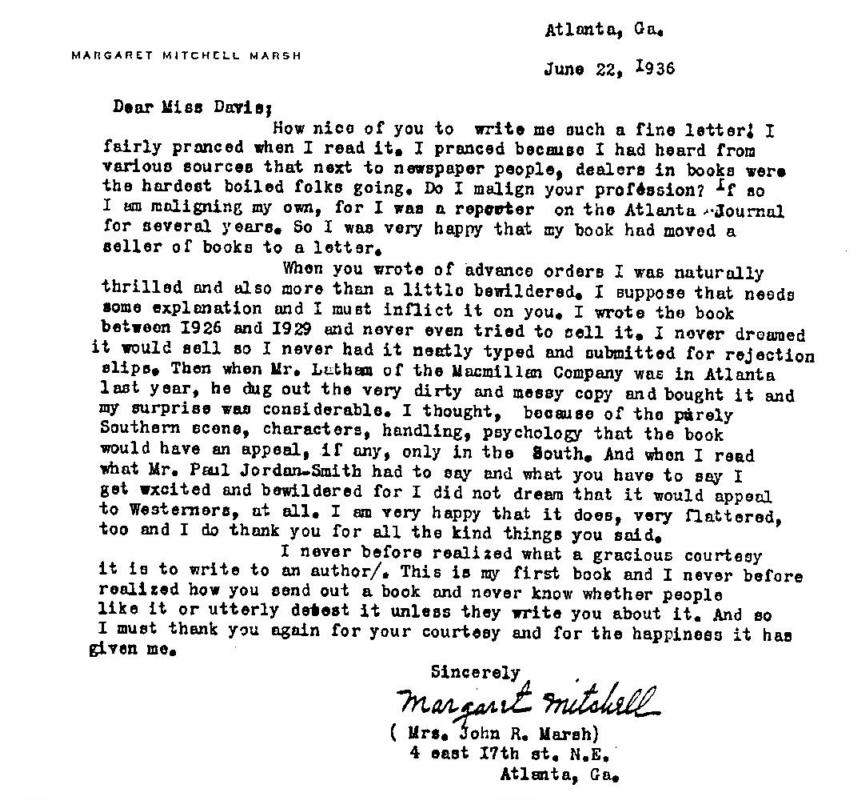
So how many times was Gone with the Wind rejected? According to Margaret Mitchell, it was never rejected. Here's an excerpt from her June 22, 1936 letter to a book dealer who had written to say she loved the novel:
I wrote the book between 1926 and 1929 and never even tried to sell it. I never dreamed it would sell so I never had it neatly typed and submitted for rejection slips. Then when Mr. Latham of the Macmillan Company was in Atlanta last year, he dug out the very dirty and messy copy and bought it and my surprise was considerable. I thought, because of the purely Southern scene, character, handling, psychology that the book would have an appeal, if any, only in the South.


Scratch one myth.

Gone with the Wind was a great book, but Margaret Mitchell didn't appear to know that. If Mr. Latham hadn't gone south to hunt for buried treasure, things might have ended quite differently.

I was charmed by what the newly-published Mitchell wrote near the end of her letter:

I never before realized what a gracious courtesy it is to write to an author. This is my first book and I never before realized how you send out a book and never know whether people like it or utterly detest it unless they write you about it. And so I must thank you again for your courtesy and for the happiness it has given me.


I'm all for writers encouraging each other. But I think we can find ways to do that without spreading false rumors and telling outright lies.

Monday, May 12, 2008

The accidental novelist

Here's a bit of encouragement for novel writers from Neil Gaiman's blog:

The second draft is where the fun is. In a first draft, you get to explode. The objective (at least for me) is to get it down on paper, somehow. Battle through the laziness and the not-enough-time and the this-is-rubbish and everything else, and just get it written. Whatever it takes. The second draft is where you go and gather together the fragments of the explosion and figure out what it is you did, and make it look like that was what you always meant to do.


Ah, yes. Make it look like you knew what you were doing all along. That's the art of writing fiction.

I have heard from a number of people who dream of being published in inspirational romance and have studied my books for clues on what makes a salable novel in that genre. Their e-mails have complimented me on things like my deft use of "symbolism" in Chapter Three and the subtle "foreshadowing" in Chapter Six. I can't tell you how often (well, I could, but it would make me look needy and pathetic) I find myself reaching for my dog-eared copy of the book in question to see if I really am as clever as these correspondents think.

Very often, I am not. Because those reader/writers are bringing their own experience and values to my stories, they're making assumptions about what I intended. But that's okay. It just means their imaginations are working hard. And if they can learn something or get inspired by reading my book five times and counting the pages in each of my chapters or studying whatever symbolism and foreshadowing they believe they have found (I don't know; maybe I did accidentally slip some in), then I am delighted.

Friday, May 09, 2008

Chick lit: Was it all about the shoes, after all?

A friend pointed me to an interesting article titled, "Women's Fiction Forecast" at Writer's Digest. The article begins:

Despite periodic rants from literary critics that chick lit shouldn't be allowed in print and fearful speculation from chick-lit writers that the genre has peaked, this trendy offshoot of romance is alive and well and filling local bookstores with pink cover art. In fact, the form has prospered so enormously that nearly every sector of popular fiction hopes to institute its own particular version.


Well, that sounds very nice. Chick lit continues to prosper. But wait. Have you clicked over to the article yet? When you do, you'll see this in bold print under the headline:

Is chick lit on the way out? Don't bet your Blahniks. Instead, the genre has branched out into surprising new arenas, offering great opportunities for aspiring novelists—and even nonfiction writers.


Yes, of course they had to bring up shoes, didn't they? Because we are, after all, talking about chick lit. And people hear "chick lit" and think "shoes" just like they hear "romance novel" and think "bodice-ripper." That's why this raised my eyebrows:

What has changed is the reader's appreciation for the depth of character and circumstances that this topic can cover, [literary agent Nadia] Cornier says. "The novels are no longer just about owning that great pair of shoes. Chick lit, in all its recently varied forms, focuses on women's lives and tribulations in a fun-filled way


Strange. A few years ago, if you had dared to suggest the novels were about little more than self-absorbed, cappucino-guzzling young women searching for the perfect designer handbag, chick lit fans would have swarmed over you and pecked you until you promised to show some respect for their genre. Chick lit is not just about owning that great pair of shoes, they shrilled back then. Chick lit comes in varied forms and focuses on women's lives and tribulations in a fun-filled way.

Now we're being told that chick lit is here to stay because it has grown; it has moved beyond its former giddy focus on shopping and shoes.

I'm confused. Either chick was exactly what some of us accused it of being or it was not. And if it wasn't all about the shoes, then why are the people who love it so eager to to have us believe the genre has grown up?

Chick lit lovers and haters, have your say in the comments.


UPDATED 2:38 PM (EST)

A just received an e-mail from Christian chick lit author Kristin Billerbeck, who said this Writer's Digest article, which carries a dateline of February 11, 2008, is in fact a few years old. She was interviewed for the article and was quoted in it, but I didn't see that because the article is showing up in my browser (even after refreshing) as a single page--and Kristin is not mentioned on the first page.

To get some idea of just how old the article might be, I looked up a couple of the book titles it mentions. They were published in 2004.

I can't imagine why WD would run an old article under a new dateline, but there it is.

Friday, May 02, 2008

Pop quiz on punctuation: using semicolons

Semicolons are fun; I use them a lot, both here on the blog and in my romance novels. I adore long sentences with snappy rhythms, so when I happen to create a good one I'm reluctant to end things prematurely by flinging down a period. Sure, the liberal use of commas and conjunctions is usually enough to keep things rolling along for a while, but nothing adds pizzazz like a semicolon.

If you're only semi-confident about using semicolons, check out this page of simple exercises to make sure you're using them correctly.

Wednesday, April 30, 2008

How to write an intriguing query letter

Why do writers obsess over query letters? If you've written anything close to a publishable novel, you surely have a good grasp of grammar and punctuation. You can put together sentences and paragraphs. You can organize your ideas. And you have a unique "voice," a knack for writing in a way that engages readers' interest. Can you really possess all of those skills and be unable to write what boils down to a simple business letter?

If you're a good writer, you can write a good query letter.

For an average-length novel, a query letter shouldn't be more than one page. That's because agents and editors will probably only glance at it. In the "Writer's Corner" of his website, Nicholas Sparks says the typical New York literary agent gets 400 query letters a month and will ask to see only three or four manuscripts. If that's true, there simply aren't enough hours in the day for those professionals to carefully read every word of every query letter. So keep your letter short and easy to read and you just might increase your chances of snagging some interest in your novel.

Let's take a look at the query letter Nicholas Sparks sent to 25 agents, including the one who ultimately represented him in the sale of The Notebook, which garnered him a million-dollar advance. Sparks says the letter required 17 drafts and two weeks to produce, and he goes on at some length about making every word count. But I found his letter wordy and repetitious and less than compelling. Look how he introduced his story:


This novel, The Notebook, is a love story inspired by two special people that recently passed away after sixty years of marriage. They were no one you would know, but there was a grand romance between them, an underlying passion and understanding that had taken a lifetime to develop. In this day and age, the unconditional love they felt for one another makes for a wonderful story, one that is all too rare and much too beautiful to let die without being told.


I like to think of myself as a romantic, but that made me yawn. Why did he squander so many words when all he needed to say was that he'd written the story of his grandparents' remarkable sixty-year romance?

Here is the most important part of his query letter:

The Notebook is the first novel that describes the heart-wrenching effects of Alzheimer's disease on two people who had loved each other all their lives.


Why did Sparks bury that sentence at the bottom of his long letter? It's the very essence of his unique story. I wonder how many of the other 24 agents tossed the letter aside without ever learning that this was no run-of-the-mill love story, but the story of an amazing lifelong love being systematically attacked by a memory-stealing disease.

Can you describe your novel in a single sentence? Try it. Then build your query letter around that sentence.

For more tips on writing query letters and to see the short, simple letter that helped sell my first book, click over to this page of my website.

Monday, April 28, 2008

Why internet anonymity is a bad idea, especially for writers

I recently joined yet another online community. As always, instead of adopting a cute nickname like "Lives2Write," I've been posting under my real name, Brenda Coulter.

Blogs, message boards, and social networking sites can be useful and entertaining. But I've always been bothered by the ease with which people who participate in those forums can insult and even threaten others while hiding behind made-up names. So I'd like to see a trend toward using real names online. It's just more comfortable to exchange messages with people who don't appear to be hiding anything.

A good internet citizen should not be afraid or ashamed of attaching her name to the words she has written online. Unlike cowardly trolls who love to hit and run, decent people who post honest opinions don't usually stray far from civility because they know they're not anonymous--and hasty words lobbed into cyberspace can rarely (if ever) be recalled.

What about privacy? If you're worried about people finding out your kids' names and ages and where you live, perhaps you should stop chatting about those things in public forums, where anyone might listen in. Internet anonymity offers far less protection than we assume, anyway; countless people have seen their true identities outed by their online enemies--and even, occasionally, by their bumbling friends. On the internet, nobody can count on being anonymous forever. So why not acknowledge that and switch all of your online community and message board accounts to your real name? That would be a step toward making the internet a nicer place for everyone.

If you're a writer, are you taking advantage of the myriad promotional opportunities afforded by online communities, or are you dropping perfectly polite and interesting comments and then failing to fully identify yourself? Agents, editors, publishers, and other writers use the internet, too, you know. So why sign "SusanA" when you can sign your real name, Susan Author, and perhaps catch the eye of someone who might further your career? Posting informative or thoughtful or humorous comments under your real name (or your literary pseudonym) is a good idea for both those who hope to get published and those published authors who wouldn't mind picking up a new reader or two.

Sure, you might be well advised to post anonymously when you go to a medical forum to ask about your hemorrhoid problem. But in general, wouldn't it be better for the internet community and for your career if you stopped calling yourself "BobWrites" and allowed people to see who you really are?

If you are moved to comment on this post, I dare you to do so under your real name.

Thursday, April 24, 2008

Real writers aren't quitters

Just ran across this bit of silliness at Times Online:

Book piracy on the internet will ultimately drive authors to stop writing unless radical methods are devised to compensate them for lost sales.

This is the bleak forecast of the Society of Authors, which represents more than 8,500 professional writers in the UK and believes that the havoc caused to the music business by illegal downloading is beginning to envelop the book trade.


My initial reaction to this gloom-and-doom prediction paralleled one of the article's commenters, who stuck his tongue firmly in his cheek and wrote:

Not writers too! I remember when all the artists stopped releasing records and Hollywood stopped making films because online piracy was so rife.


Another commenter responded this way:

Writers will never stop writing. We couldn't stop even if we wanted to.


Most writers realize they'll never make a comfortable living banging away at their keyboards. But does that stop us? No. In fact, millions of us are already writing for nothing at all. (We call those writers "unpublished.")

It's often said that anyone who can quit writing should quit. This is a hard business. Sometimes even your best just isn't good enough, and agents and editors won't soften the blow to your delicate psyche but will tell you flat out that they just don't want your stuff. Even if you score a publishing contract, you can still end up with lots of wounds to lick. Your publisher might not promote your book and you might not sell enough copies to earn out your advance. Reviewers might trash your writing. And every time you open your mouth to complain, somebody will tell you to toughen up, because that's the business.

Writers who keep going in the face of real obstacles like those aren't likely to stop writing just because somebody has uploaded all of their books to an internet file-sharing site. Real writers are, by definition, not quitters.

I'm embarrassed that a writers organization has suggested otherwise.