Showing posts with label writers. Show all posts

Saturday, June 11, 2011

Great video: 29 Ways to Stay Creative

I'm posting this especially for my writer pals, but I think the rest of you will appreciate it, too.

Now, everyone get out there and have a great weekend!

29 WAYS TO STAY CREATIVE from TO-FU on Vimeo.

Thursday, December 11, 2008

Why my writing rule is "No rules"

Literary agent Chip MacGregor on submissions:


I'd like to see more writing with a strong voice. I probably see too many things that aren't bad -- they're just not outstanding. They don't have a particular personality that stands out and demands to be read. There's a lot of flatness in writing (conferences have a tendency to foster that, by telling prospective authors there is a "right" way to do things), and I'm always interested in the clear, quirky, outstanding voice coming out on the page.


I couldn't agree more that workshops at writers' conferences foster "flatness" in writing by teaching that there is one correct way to write.

I have published only four books, but many people would say I'm qualified to call myself "multi-published" and write articles or teach conference workshops on how to plot, how to write interesting dialogue, how to create believable characters, and so on. But I say I am not qualified to teach those things. I might be able to offer a useful tip here and there, but I'm no authority on what it takes to write a great inspirational romance novel and get it published. Perhaps because I write in a very "organic" way, I couldn't begin to teach anyone how to do what I do. Even if I could, wouldn't you rather write like yourself than like me?

Conferences like RWA and ACFW allow far too many inexperienced, mediocre authors to dispense advice to gullible unpublished writers. Online writers' forums and e-mail loops exacerbate the problem when newbies who have latched onto certain "writing rules" share them with their even-newbier pals and everyone gets caught up in unimportant details. Here are just four of the silly things some writers have come to believe are keys to getting published:


Don't use any dialogue tag but "said", which is invisible to the reader. Other dialogue tags intrude.

Never use adverbs with your dialogue tags.

After you've written the first five chapters, throw Chapter One out and begin your story with Chapter Two. You can't possibly write a good first chapter--you will always put too much backstory in it.

Never use italics. That's weak writing.


There are many more, of course. And as Chip suggests, the more of these rules we all take to heart, the less distinct our individual writing voices will become. That's doubly unfortunate, because you can follow every rule and still not get published.

The real secret to getting published is: Write a ripping good story. Even if you're a little lavish with your adverbs, and if you get silly (as I do) about italicizing words, and if you occasionally write "he opined" or "he sputtered" instead of "he said," and if you break just about every other Writing Rule you so eagerly recorded in your conference notebook while sitting through all those workshops, chances are good that a publishing professional won't care because those are small things, fixable things, and they'll be well worth correcting in order to publish your amazing story.

So if anyone wants some free advice from yet another "multi-published" romance writer, here you go:


No rules.
Just write.


Be yourself. Tell your story. And have fun!

Monday, August 11, 2008

Please don't tell me how to write better

One of the writers' e-mail loops I used to follow closely has become such an annoyance that in the past couple of weeks I've been deleting nearly all of the messages unread. What's the problem? Too much advice on the craft of writing.

The group welcomes both published and unpublished novelists, not just romance writers, so we have a good mix of people for sharing encouragement and industry tips. But I've grown weary of these and other endlessly repeated one-size-fits-all writing rules:

Using italics is a sign of weak writing.

Long sentences make readers lose interest.

Adverbs should be used sparingly, but they should never be used in dialogue tags (she said forcefully).

Strive for a good balance between narrative and dialogue.

Semicolons have no place in novels.

Because "said" is invisible to readers, it's the only dialogue tag that should ever be used.


As the title of this blog suggests, I tend to scoff at writing rules. But in recent weeks I've been bombarded with the above bits of "writerly wisdom," some of the advice from people who haven't yet managed to sell their first novels and some from published novelists whose writing styles I don't admire and have no desire to emulate. I've noticed that the writers I do admire (and of course I'm talking about art, not personalities) don't tend to go around spouting rules.

I'm not saying my writing is any better than that of my eager advisers. I am a competent writer, but not an insanely talented one. While I'm still attempting to hone my craft, I have no illusions that I will ever be a great writer or even a bestselling one--and the truth is that I don't even dream about those things. But over the past couple of weeks I've decided that I don't want free writing advice from other writers. I want to read more, and when I find a technique I admire, I want to examine it and figure out how it works and see if I can find a way to make it work for me.

Before selling my first novel, I never took a class, read a how-to book, or submitted pages for anyone to critique. I just read a lot of good books. I stole a few ideas, adapted a style here and there, and found a way of writing that felt right to me. I use adverbs and italics with abandon, and I believe semicolons are darn useful. I think a long sentence can be the juiciest part of a paragraph, and I usually end up with way more narrative than dialogue. And I just don't agree that "said" is invisible to readers, so I use other dialogue tags to keep things interesting.

You may have different opinions on all of those things, and that's fine with me. Just understand, please, that before I take advice from another writer, I'm going to insist on seeing some examples of your work. Your being a contest judge or a writers' workshop presenter or "multi-published" or a New York Times bestseller or a Pulitzer Prize winner won't make you an authority in my eyes unless I love the way you write. And even then, your style might not work for the kind of books I like to write.

But as I said, the really great writers don't often post writing rules like "never use semicolons" on writers' message loops. So I guess I'm still on my own.

Friday, May 23, 2008

Writing with my eyes open

How many other novelists, I wonder, avoid looking at their words as they type them onto the page? I'm actually a fairly fast and accurate typist, but somehow watching my words come out one a time distracts me and disrupts their flow.

So I don't watch.

Sometimes I write with my eyes shut, my head thrown back like Stevie Wonder at his piano, pushing words through my fingertips in the same joyous way he pushes music through his. But most of the time I'm looking over the screen of my laptop and out the window opposite my desk. It's just a normal-size window, but it affords me a partial view of our patio garden and beyond that, several mature black walnut trees and a bit of sky--in other words, plenty of light and color and movement to stimulate my imagination.

I would have taken my computer out into the garden this afternoon, but it's been looking like rain. A little while ago I went out with the idea of moving this pot of daisies and petunias in front of my office window (the one on the left side of this photo) so I could enjoy the jazzy orange-and-purple bouquet from my desk. But alas, the stand was too short. So I returned to my desk, where I spent a good five minutes watching two fat robins splash in the bird bath.

I've decided that the view from this window doesn't need improving, after all.

Monday, May 19, 2008

Q: How many times was Gone with the Wind rejected?

A: Zero.

That's right, zero. Yet twice in the past few days, I have seen writers in online forums tell others that Margaret Mitchell's Gone with the Wind was rejected "over 50 times" before a publishing contract was offered. Ever skeptical, I Googled "Gone with the Wind" with "rejected" and found several more claims in that vein. Here's one from HowStuffWorks:
The story of Scarlett O'Hara and Rhett Butler, set in the South during the Civil War, was rejected by 38 publishers before it was printed.


This factoid and others like it are often trotted out in writers' forums by people who hope to console themselves and other writers whose manuscripts have been rejected by publishers and literary agents. While I understand the desire to share that pain and give each other pep talks, I squirm at any suggestion that writers should be patient because there is a magic number of years or submissions for each of us, a point at which we will have worked hard enough and waited long enough and submitted enough times to earn publication.

It just isn't true that every talented writer will eventually be published if she works hard enough and waits long enough and believes. Novels don't get published because their authors have faithfully paid their dues and waited their turn. Publication isn't a bus that anyone can catch as long as they have the correct fare and show up at the right stop at the scheduled time.

A novel is accepted only when some publishing house believes it can make money on the book. Period. So the difference between a published author and an unpublished one does not always boil down to talent and experience. Sometimes the difference is, quite simply, marketability.

Am I saying that unpublished writers should give up after a flurry of rejections? Of course not. Who can say whether a writer's next submission will bring her the success she longs for? I imagine there must be a lot of great books that were rejected fifty times before they were published. I'd just like to see more writers behaving like grown-ups instead of latching onto any publishing myth that makes them feel good. Believing in ourselves accomplishes nothing if we're not also facing reality and doggedly confronting the obstacles before us.

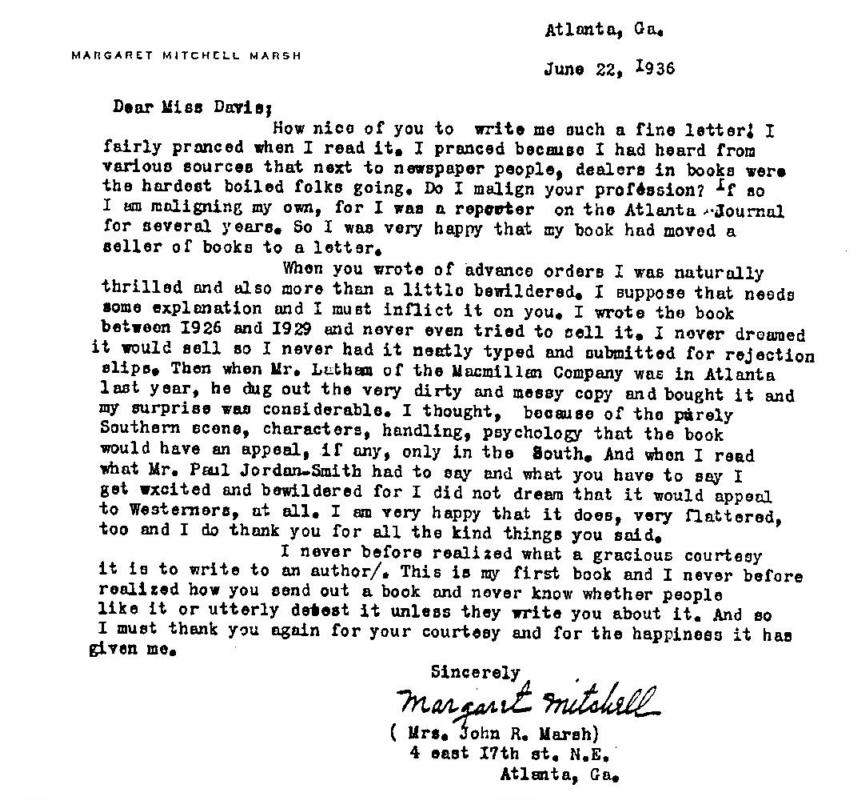
So how many times was Gone with the Wind rejected? According to Margaret Mitchell, it was never rejected. Here's an excerpt from her June 22, 1936 letter to a book dealer who had written to say she loved the novel:
I wrote the book between 1926 and 1929 and never even tried to sell it. I never dreamed it would sell so I never had it neatly typed and submitted for rejection slips. Then when Mr. Latham of the Macmillan Company was in Atlanta last year, he dug out the very dirty and messy copy and bought it and my surprise was considerable. I thought, because of the purely Southern scene, character, handling, psychology that the book would have an appeal, if any, only in the South.


Scratch one myth.

Gone with the Wind was a great book, but Margaret Mitchell didn't appear to know that. If Mr. Latham hadn't gone south to hunt for buried treasure, things might have ended quite differently.

I was charmed by what the newly-published Mitchell wrote near the end of her letter:

I never before realized what a gracious courtesy it is to write to an author. This is my first book and I never before realized how you send out a book and never know whether people like it or utterly detest it unless they write you about it. And so I must thank you again for your courtesy and for the happiness it has given me.


I'm all for writers encouraging each other. But I think we can find ways to do that without spreading false rumors and telling outright lies.

Monday, May 12, 2008

The accidental novelist

Here's a bit of encouragement for novel writers from Neil Gaiman's blog:

The second draft is where the fun is. In a first draft, you get to explode. The objective (at least for me) is to get it down on paper, somehow. Battle through the laziness and the not-enough-time and the this-is-rubbish and everything else, and just get it written. Whatever it takes. The second draft is where you go and gather together the fragments of the explosion and figure out what it is you did, and make it look like that was what you always meant to do.


Ah, yes. Make it look like you knew what you were doing all along. That's the art of writing fiction.

I have heard from a number of people who dream of being published in inspirational romance and have studied my books for clues on what makes a salable novel in that genre. Their e-mails have complimented me on things like my deft use of "symbolism" in Chapter Three and the subtle "foreshadowing" in Chapter Six. I can't tell you how often (well, I could, but it would make me look needy and pathetic) I find myself reaching for my dog-eared copy of the book in question to see if I really am as clever as these correspondents think.

Very often, I am not. Because those reader/writers are bringing their own experience and values to my stories, they're making assumptions about what I intended. But that's okay. It just means their imaginations are working hard. And if they can learn something or get inspired by reading my book five times and counting the pages in each of my chapters or studying whatever symbolism and foreshadowing they believe they have found (I don't know; maybe I did accidentally slip some in), then I am delighted.

Monday, April 28, 2008

Why internet anonymity is a bad idea, especially for writers

I recently joined yet another online community. As always, instead of adopting a cute nickname like "Lives2Write," I've been posting under my real name, Brenda Coulter.

Blogs, message boards, and social networking sites can be useful and entertaining. But I've always been bothered by the ease with which people who participate in those forums can insult and even threaten others while hiding behind made-up names. So I'd like to see a trend toward using real names online. It's just more comfortable to exchange messages with people who don't appear to be hiding anything.

A good internet citizen should not be afraid or ashamed of attaching her name to the words she has written online. Unlike cowardly trolls who love to hit and run, decent people who post honest opinions don't usually stray far from civility because they know they're not anonymous--and hasty words lobbed into cyberspace can rarely (if ever) be recalled.

What about privacy? If you're worried about people finding out your kids' names and ages and where you live, perhaps you should stop chatting about those things in public forums, where anyone might listen in. Internet anonymity offers far less protection than we assume, anyway; countless people have seen their true identities outed by their online enemies--and even, occasionally, by their bumbling friends. On the internet, nobody can count on being anonymous forever. So why not acknowledge that and switch all of your online community and message board accounts to your real name? That would be a step toward making the internet a nicer place for everyone.

If you're a writer, are you taking advantage of the myriad promotional opportunities afforded by online communities, or are you dropping perfectly polite and interesting comments and then failing to fully identify yourself? Agents, editors, publishers, and other writers use the internet, too, you know. So why sign "SusanA" when you can sign your real name, Susan Author, and perhaps catch the eye of someone who might further your career? Posting informative or thoughtful or humorous comments under your real name (or your literary pseudonym) is a good idea for both those who hope to get published and those published authors who wouldn't mind picking up a new reader or two.

Sure, you might be well advised to post anonymously when you go to a medical forum to ask about your hemorrhoid problem. But in general, wouldn't it be better for the internet community and for your career if you stopped calling yourself "BobWrites" and allowed people to see who you really are?

If you are moved to comment on this post, I dare you to do so under your real name.

Thursday, April 24, 2008

Real writers aren't quitters

Just ran across this bit of silliness at Times Online:

Book piracy on the internet will ultimately drive authors to stop writing unless radical methods are devised to compensate them for lost sales.

This is the bleak forecast of the Society of Authors, which represents more than 8,500 professional writers in the UK and believes that the havoc caused to the music business by illegal downloading is beginning to envelop the book trade.


My initial reaction to this gloom-and-doom prediction paralleled one of the article's commenters, who stuck his tongue firmly in his cheek and wrote:

Not writers too! I remember when all the artists stopped releasing records and Hollywood stopped making films because online piracy was so rife.


Another commenter responded this way:

Writers will never stop writing. We couldn't stop even if we wanted to.


Most writers realize they'll never make a comfortable living banging away at their keyboards. But does that stop us? No. In fact, millions of us are already writing for nothing at all. (We call those writers "unpublished.")

It's often said that anyone who can quit writing should quit. This is a hard business. Sometimes even your best just isn't good enough, and agents and editors won't soften the blow to your delicate psyche but will tell you flat out that they just don't want your stuff. Even if you score a publishing contract, you can still end up with lots of wounds to lick. Your publisher might not promote your book and you might not sell enough copies to earn out your advance. Reviewers might trash your writing. And every time you open your mouth to complain, somebody will tell you to toughen up, because that's the business.

Writers who keep going in the face of real obstacles like those aren't likely to stop writing just because somebody has uploaded all of their books to an internet file-sharing site. Real writers are, by definition, not quitters.

I'm embarrassed that a writers organization has suggested otherwise.

Tuesday, April 22, 2008

Getting published: Why agents and editors don't owe you a thorough read

Last week on his blog, literary agent Nathan Bransford quoted Benjamin LeRoy, the publisher of Bleak House books:

"As soon as I see awkward prose on page one, I reject a book. You wouldn’t trust a clumsy surgeon with a scalpel. I don’t trust authors who aren’t in complete control of their environment. Sloppy work is sloppy work. Doesn’t matter the profession, I don’t want it."

[Mr. Bransford continues] This is very true, and perhaps the number one reason I reject queries and partials: awkward prose.


As a reader, I do the same thing. If page one of a novel rubs me the wrong way, I'm done. There may be a great story coming, but that's immaterial if the author is incapable of putting clear, graceful sentences together. I don't have the patience to wade through bad writing in the hope of finding a good story. Not when there are so many good novels waiting to be read.

Here's more from Nathan Bransford:

I'm skeptical when people tell me they can write a compelling novel but not a query letter. Do you have a command of words or not? What if you need to craft a short, wonderful scene in your novel? You can't marshal the words to write it because it's too short of a space? You can't convey a great deal of information with an economy of words?


A successful novelist possesses much more than a lively imagination and a talent for constructing compelling stories; she is able to communicate clearly and effectively via the written word. Some novelists are better than others when it comes to writing query letters and synopses, but all publishable writers should be adept enough at handling words to write effective queries and synopses. (If you aspire to publish romance novels, check my website for advice on writing query letters and synopses.)

I'm sure many of us would be surprised to know just how often editors and agents toss aside query letters and manuscripts after reading only a couple of paragraphs. But why should they read further? If a writer has failed to prove her publication-worthiness on page one, what are the chances that she's going to be able to do it by page twenty-five?

There's a classic submitting writers' trick designed to prove whether an editor or agent has given a manuscript a "fair read" before rejecting it: the writer puts in one of the middle pages pside-down. If the manuscript is returned that way, the writer grumbles that she's been cheated by the insensitive, unprofessional editor or agent. But no publishing professional--even one who has requested a partial or full manuscript--owes those writers anything. Form-letter rejections are not insults. Any writer who thinks otherwise should examine her own responses to people who try to sell products to her. When we turn down a telephone solicitor, do we say "no, thanks" or do we offer a detailed critique of his product and then explain why it just doesn't suit our needs at this particular time?

Writers who bellyache in online forums and at writers' conferences about how nobody's giving them a chance don't seem to understand that editors and agents do not exist to dispense free manuscript critiques--even of the one-line variety--to uncontracted authors. The job of an editor or agent is to spot talent, contract that talented writer, and then help her craft a wonderful book so that everyone can make money and get famous.

So if a publishing professional actually reads your entire manuscript before rejecting it, or if she offers you any response beyond a simple "no, thank you" (and that does happen), she has done more than her job; she has done you a favor.

Monday, April 21, 2008

The self-satisfied author

In a comment on Friday's post at Romancing the Blog, author Laura Kinsale wrote:

...I’ll issue the warning of long experience to those aspiring authors who think the best thing about writing is the reader reaction. You are playing with cocaine there. Because once you get hooked on it, you will find it’s got YOU by the tail.


Aspiring authors? I know a boatload of published authors who, from the sound of things, are writing primarily to be adored by their readers. They actually say things like, "Look at this great fan letter I received. This is what makes it all worthwhile."

I always cringe when I hear that and privately hope reader adulation isn't really the reason those people are writing romance novels. Sure, it's wonderful to hear that the story you worked so hard on has touched your readers' hearts. But anyone who's writing primarily to be admired as a writer is missing out on a lot of joy, I think.

Many authors never read their books after the books are published. But I read mine, and not just once or twice. I bet I've read my first book, Finding Hope, at least six times. Yes, cover to cover--after it was published. Why? Because my greatest satisfaction in writing comes from my reaction to what I've written. I'm like Joan Wilder in the opening scene of Romancing the Stone. My own writing tickles me.

To reread one of my published books is to relive the satisfaction of writing it; to recall the jolt of joy I felt the afternoon I made up that killer-funny scene at the awards dinner in Finding Hope or to revisit the day I was struck by the notion that giving the beleaguered heroine of A Family Forever a miscarriage would send her into an emotional tailspin that would make that story. Every chapter and every scene in my finished books is a reminder of the challenges I faced and overcame during the writing process.

Sure, I'm gratified when readers say something I've written has touched their hearts or made them think or even Changed Their Lives (inspirational romance writers get that one a lot). But all that is icing, not cake; and I am writing for the cake. I relish the challenge of overcoming one obstacle after another, moving relentlessly forward until I have created a story that pleases me.

Maybe my author friends don't actually believe their writing is only worthwhile if other people like it. I hope they don't believe that because if they do, they're missing out on some seriously huge thrills in their writing lives.

Tuesday, March 18, 2008

Quiet please. We're writing.

This afternoon I was browsing How I Write: The Secret Lives of Authors, edited by Dan Crowe, and came across a short piece by Nicholson Baker on wearing earplugs while writing. Here are the last three paragraphs:

I can sit anywhere, in any loud place, and work. Everything becomes twenty feet farther away than it really is. The chirping, barking, jingling cash-drawer of a world is out of reach, and therefore more precious.

You must have a good seal. When you unstick your thumb from a jammed-in plug, your eardrum will make a tiny silent cry of pain, like a word in Arabic.

Then you know you have a good seal.


I am very familiar with that Arabic word, as I often hear it when removing the ear buds of my iPod.

I wrote my first novel on the family room computer, with teenagers running in and out, the TV blaring, and the clothes washer and dryer humming in the background. But now I feel tremendously blessed to have a quiet home office. I also like writing in my back garden when nobody's around. I don't need silence to write, but in most moods I prefer it.

How do you like to write? Are you more likely to crank up the stereo, or to seek a quiet spot when you work on your stories?

Tuesday, March 04, 2008

Advice to unpublished writers: Learn how to wait

From the blog of literary agent Nathan Bransford:

1) I've been receiving way more queries than usual.

2) The quality of these queries, on average, is WAY below normal.

Obviously there have been some pleasant exceptions and, if you read this or other agent blogs, even if I passed on your project the overwhelming odds (because you're awesome and doing your research) are that yours was one of the good ones. But on average, these queries I've been receiving lately are way way way worse than normal, like a train wreck on top of a volcanic explosion of cow dung (yay similes!)

What's going on out there?


I'll venture a guess.

If I were an editor or a literary agent and if I generously began dispensing free writing advice via a blog and if the people who discovered that blog liked it and told their friends, I believe I would expect to start getting a lot more queries than usual. And I would assume that many, many of those queries would not be carefully executed, but would come from clueless individuals who got excited and fired off pages and pages of garbage after asking themselves, "Why not? What have I got to lose?"

The internet has been a boon to writers. These days, if a wannabe writer can't afford to buy an armload of books on writing and can't attend writers' workshops, she can find all kinds of free advice--much of it very good--right here on the internet.

That's a wonderful thing--for the writers. Unfortunatley, this easy access to information means that nice, helpful professionals like Nathan Bransford are setting themselves up to be ambushed by writers with far more enthusiasm than talent and common sense. He seems to realize that, but who can blame him for grumbling a little:

...e-queries, because of their relative ease of use, have an unfortunate tendency to inspire some people to spend less time perfecting their query, somehow leads them to think it's a good idea to blast the entire industry with one e-mail, and/or prompts them to write a five hundred page query letter (I guess because they don't have to pay for the paper).


He continues:

...I'm getting exhausted spending the first several hours of my day wading through a morass of bad query letters. I'm still going to adhere to my policy of responding to everyone who queries me, but anyone who complains about agents not responding to queries should really spend several hours reading through 100+ queries every Monday morning.


I would advise unpublished writers to do their homework and polish their queries before approaching Mr. Bransford and his colleagues, but unfortunately, the people who most need to hear that advice are the people least likely to accept it. So to you smart cookies who have done your homework: be patient. If it takes a few months for an agent or editor to respond to your short, well-written query letter, bear in mind that before they get to yours, they must wade through hundreds or even thousands of long, badly-written ones.

Just keep writing and keep submitting. There's no way to hurry up the responses from editors and agents, so the best use of your time while waiting is to improve your writing skills and get more projects ready for submission.

Friday, February 29, 2008

Because he's not a writer, that's why

Apparently, Rob Lowe got a little bored during the three-month Writers Guild of America strike; nobody was writing, so he couldn't do his thing, which is acting.

Suddenly Rob had a Big Thought: He would write his memoirs! He would do it all by himself, without a ghostwriter!

Publishers loved the idea. An auction ensued. The winning publishing house agreed to give Rob a million-dollar advance. Rob was ready to buy legal pads and sharpen his pencils.

And then, whoops, the WGA strike ended. Now Rob is acting again, which means he's too busy to write a book. Here's an excerpt from an article in The New York Observer:


The deal was just about ready to go—Mr. Abate [Rob Lowe's agent] had informed Mr. Karp [of Hatchette Book Group] that he had prevailed in the auction and contract negotiations were under way—when, on Wednesday the 13th, the writers' strike up and ended, and Mr. Lowe suddenly became an actor again.

Over the course of the next few days, as Hollywood rose from its three-month slumber and everybody went back to work, Mr. Lowe's schedule filled up quickly. First, according to Mr. Abate, ABC ordered something like 30 new episodes of Mr. Lowe's TV show, Brothers & Sisters. Then two major film projects emerged. Suddenly the next year was looking pretty busy, and Mr. Lowe had to face the fact that he just wouldn't have time to write his book.

"He is just booked for at least the next year straight," Mr. Abate said. "We're going to come back to Karp when he's done shooting all these things, if there's time then to do it. He doesn't want to commit to it because he doesn't know what he's going to be offered between now and then."


Okay, we get it. Rob Lowe's top priority is acting. Forget what he promised the publisher; he got a better offer and he had to go with it.

All of this has me wondering: Just how long did Rob Lowe think that writer's strike was going to last? Or is it simply that he thought he could knock off those memoirs in a long weekend or two?

Nonwriters. They just don't get it. Real writers write because they have to. Unlike Rob Lowe, they write even when they don't have time to write. They'll do without sleep if they must, writing between the hours of 4 and 6:00 a.m. before heading off to their day jobs.

But not Rob. Because Rob is not a writer. He just played one on TV.

Tuesday, February 26, 2008

Writing all our lives

My 52nd birthday is nipping at my heels, and I was just thinking about how much I love writing and how glad I am that if I keep my mind sharp and don't give in to the arthritis stiffening my fingers (which is one reason I don't do booksignings--it's just too uncomfortable to hold a pen for very long), I should be able to write for as many years as God is pleased to leave me here on earth. Unlike dancers and basketball players who must hang up their shoes at young ages and unlike corporate types who turn 67 and are promptly given their gold watches and shown the door and unlike just about all other workers who retire just as their bodies begin to give out, writers who love what they do can go on and on and on. Even a very old, physically infirm writer can continue to publish books. She may not be attractive and energetic enough to get on Oprah, but otherwise, she'll face no discrimination based on her age.

Novelist Phyllis A. Whitney passed away on February 8 at the age of 104. She had begun writing as a teenager, and soon after finishing high school she was publishing short stories. She was 38 years old when she published her first book, a novel for young adults. Two years later, she published her first adult novel, Red is for Murder. In all, she penned more than 75 books, including three textbooks.

She was in her nineties when she published her last novel, Amethyst Dreams (1997), but she was still writing when she died: she left behind an unfinished autobiography.

I am sure her readers and admirers wish she'd had a little more time. But isn't it wonderful that she kept writing for as long as she did?

"It's hard to come up with a 'quote' about myself. Perhaps I could say that most of my writing has been concerned with understanding between people. Whether of different races, or religions, or even in the same family I tried in my books... to deal with the subject of understanding the other fellow."

-- Phyllis A. Whitney


You can read more at Phyllis A. Whitney's official website.

Thursday, January 31, 2008

Writing by instinct

Today was a great writing day for Neil Gaiman:

Still on Chapter Seven of The Graveyard Book, but I'm well into the last half of the chapter, and it no longer feels like I'm walking towards the horizon, with the horizon retreating as I advance... I've written about eleven easy pages today, and cannot wait to get back to it. If I'm still awake and writing I may pull an all-nighter.

It barely feels like I'm writing it. Mostly it feels like I'm the first one reading it.


I felt a delicious little thrill of recognition when I read that. It doesn't happen every day or even every week, but quite often I become so deeply absorbed in my work that it's difficult to believe I am actually writing the words that are leaping onto my computer screen. It's a terrifyingly wonderful thing when your mind comes unlatched and the story spills out and you're afraid to get another cup of coffee or answer the phone because you can't take your hands away from the keyboard, not even for a moment, or the magic might stop.

I wonder if that happens to all writers or just to those of us with a certain type of writing personality (please note that I am not associating this phenomenon with talent or experience). It happens quite a lot to me.

How about you?

Tuesday, January 08, 2008

How to kill your darlings without remorse

More from Neil Gaiman:

I'm more or less happily writing Chapter Six of The Graveyard Book. I say more or less as I'm at that place where I hope that the book knows what it's doing because right now I don't have a clue -- I'm writing one scene after another like a man walking through a valley in thick fog, just able to see the path a little way ahead, but with no idea where it's actually going to lead him.


And there you have it, folks. Novelists don't always know where their stories are headed. In fact, some of us never know. One way of writing is to imagine a good ending and then work out how to get your characters there. Another way (my way), is to hang on for dear life while your characters take you where they will.

I remember an old New Yorker cartoon (I think it was) from more than twenty years ago in which a physicist stands before a blackboard filled with a long, scary-looking formula. The gobbledygook on one side is linked to the gobbledygook on the other side by the words, "...and then a miracle happens." In the caption, one scientist tells his colleague, "I think you need to be more specific here in Step Two."

To a student of science, that's hilarious. But to a writer, it's... Well, it's life. Many of us, at least much of the time, have no earthly idea what's supposed to happen in Step Two. We tell our editors, "I don't know how I'll manage it, but I'm sure something will occur to me very soon."

I found myself in that place (having no earthly idea where I was headed) just yesterday as I labored on my work-in-progress. I've got a great set-up, two very likable protagonists, and lots of the heart-squeezing emotion romance readers clamor for. I'm excited about the story, but I don't know how it's going to end. I'm confident that everything will work out, however. I'm having a blast writing it, and that excitement is plenty of fuel to carry me all the way to the end.

They say a sculptor views a block of marble, imagines a statue, and then chips away every bit of stone that isn't the statue, thus revealing the work of art. That's how I write. My "block of marble" is the first draft of my story, which tends to be at least thirty percent and often fifty percent longer than the 55,000 words my editor wants. But that's fine. I take that draft and patiently chip away everything that isn't my story. I am a ruthless scene-killer, an unremorseful conversation condenser, a wild-eyed wielder of the Delete key. I used to save some of the better quality material that I cut, just in case I wanted it later. But I never did want it, so I no longer save it. There's plenty more good stuff where that came from. If I change my mind and want to reinsert a deleted scene, I just write it again and make it even better than last time.

Is it a waste of my time to write so much more than I know I'm going to use? No, because all writing is practice for more and better writing.

"Killing your darlings" is what many writers call deleting paragraphs, scenes, and even chapters that they've spent hours creating--all for nothing, they often believe. But a writer who can't stomach killing any of her darlings is not focusing on the big picture: her story as a whole. You may hate cutting scenes that are hilarious or poignant or suspenseful, but to be a good writer, you must do exactly that. If anything that you've written, no matter how beautifully, doesn't move your story along, it will bog your story down. By saving your "darlings," you might be killing your story.

Here's a writing tip some of you might be able to use: After finishing your first draft, find the highlighting tool in your word processor and then start reading, using the highlighter to indicate all of the sentences, paragraphs, and scenes that are absolutely essential to your story. (I use a yellow highlighter to remind myself that those parts of the story are "golden.") When you finish, delete everything that isn't highlighted. Save it in a Dead Darlings file if that makes you feel better, but I predict that after a while you'll stop bothering with that.

Now you're left with nothing but story. Your manuscript is still in very rough form, but there's not a boring bit in there because you've taken all of the irrelevant stuff out. Now you're ready to revise and polish. I go through many drafts on a book, so I do a highlighting pass after finishing my first draft, then do it again when I'm nearly finished with the manuscript. After some more tweaking and polishing, I use the highlighting tool a third and final time. When the manuscript is all golden, I'm finished. (Two notes: First, the highlighter is invaluable to me because except during that first pass, I'm not starting at Page One and progressing to the end of the manuscript. I jump around, working on whatever scenes and chapters I'm in the mood to work on. The highlighting tells me what I've finished and what still needs to be looked at. And second, on the last highlighting run I'm just deleting words and sentences, not whole paragraphs and scenes. It's all pretty painless by that time.)

I love every part of the writing process, but bringing a story home--making that final pass with my yellow highlighter and assuring myself that every sentence, paragraph, scene, and chapter is "golden" satisfies my writer's heart on the deepest level. This is the best that's in me--at least until my editor points out something that I've missed!

Monday, January 07, 2008

Trust me: This is NOT how writers get their ideas

On Saturday, Neil Gaiman posted the following on his blog:

This is an extract from a letter that came in a few days ago, and one or two letters like this tend to come every week:

...I am not a writer - I neither have the passion for it nor any amount of experience - but I have an idea for a story that I think, if done properly, could be absolute gold (both artistically and financially)! I will work with someone someday and it will be done, for it is too good not to complete. However, I am asking you because I admire your work immensely, because I think if you ever by chance hear me out you'll like it...


Here's part of Mr. Gaiman's reply:

There is a hunted expression you can see on the faces of writers. All you ever have to do, if you want to see it, is to walk over to a writer of fiction and say, "You know, I have an idea for a story. I'll tell it to you and you can write it and we'll split the money fifty-fifty." You will watch their smiles glaze over and watch them back away. Because no matter how good the idea, the execution is everything. And the real work is done at the keyboard or huddled over the notebook, putting one word down after another.


I don't receive nearly as many of those "please write my story" e-mails as Mr. Gaiman, but I do get two or three every month. Here's a snippet from a blog entry I posted two years ago and called "No, I won't write your book":

No published author worth her salt is going to give you a piece of her action. The authors I know are proud of the work they do, and they don't want or need "helpers" giving them story ideas. Although nonwriters often assume that writers worry about running out of story ideas, in fact the imagination is like a muscle; it becomes stronger with regular exercise. So a working author is not running out of ideas....

Writing a salable novel takes a whole lot more than an idea. Ideas are the easy part, and I don't know any romance author who wants help in that area. We want to write our own stories, not yours.


On Saturday, the same day Neil Gaiman posted that how-about-a-collaboration letter, I received an e-mail from Janie M. from Wisconsin, who wondered if I'd be interested in writing her life story. I didn't read past the first couple of paragraphs (the message was long and my attention span is, regrettably, not), but I quickly discerned that Janie was not a reader of my books, my website, or this blog. Clearly, this particular message was intended for mass consumption--so I wondered how many of my writing friends would end up getting it.

An hour or two later, the first message came through one of the writers' e-mail loops I read: Has anyone received the e-mail from Janie M. about writing her life story? Shortly after that, a similar message came through on another loop. I replied to both, said I had received Janie's e-mail, and invited my fellow authors to copy my response to it: I'm afraid the only stories I'm interested in writing are the ones that come out of my own head. Imagine how Janie will scratch her head, I wrote to my friends, when she gets the exact same e-mail from a dozen of the authors she approached.

All right, that's a little snarky, but Jamie imposed on us. Here on the internet we have a name for people who send unwanted, unsolicited business propositions to long lists of complete strangers; Janie spammed us, pure and simple.

I often get "let's collaborate" e-mails from readers of my books, my website, or this blog. But while I do get a little tired of explaining that I don't write other people's stories, those e-mails are hardly unsolicited; in the back pages of my books, as well as on my website and here on the blog, I always invite readers to contact me. But there's a world of difference between those messages and the one that Janie sent.

She's probably quite sincere in her belief that her life story will resonate with readers. And I doubt that she realizes how her e-mail irritated the authors she addressed. I don't know how many of the writers will ignore her message and how many will send a polite reply. But this, I do know: None of us wants to write your story, Janie. We're all too busy writing our own stories.

Friday, January 04, 2008

Seven easy steps to publication?

There's an old joke in which a man manages to save himself from falling from a cliff by grabbing a tree branch just as he tumbles over the edge. Realizing that he's unable to reach safety on his own, he calls out in desperation: "God, I don't know if You're really up there, but if You are, would You please save me?"

"I'm here," God says, "and I will save you. But first you have to trust me. Let go of the branch."

The guy thinks about that for a few seconds, and then asks, "Is there anybody else up there?"

I was reminded of that joke yesterday when I read this bit in The Kenyon Review about one individual's near obsession with studying how-to-write books:


There are the favorites—Natalie Goldberg’s Writing Down the Bones and Wild Mind which I return to often for their simplicity. Anne Lamott’s Bird by Bird is another favorite. Perhaps these books remind me that to write, I must write. And yet, I have trouble taking this advice no matter how many times I hear it or read it; I have trouble sitting in the chair (mostly because I think I should be churning out something life altering, and 99% of the time it’s garbage). Conversations with other writers always end with the same thing: writing is hard. It’s hard work.


Later, the author admits:

...I can’t deny that I’m a bit young and a bit afraid of looking or sounding stupid. So, better to have failed while hardly trying, then to have tried hard, and failed, right?

Of course, this is why those many many people out there, like me, keep looking for the book to change their lives. We want the magic elixer! The snake oil! The super duper pill!


As the joke at the beginning of this post suggests, it's human nature to look for shortcuts and quick fixes. Even when we know the correct way to proceed, we tend to keep our eyes peeled for an easier way; a way that doesn't require quite so much time and effort and faith on our part. That's why many unpublished writers continue to pore over how-to-write books in search of faster, easier paths to publication. They can't bring themselves to accept the truth that there are no shortcuts, no secret handshakes, no Seven Easy Steps To Publication. They put off writing because writing is hard and it's frustrating because they can't do it well enough to make a good agent or editor sit up and take notice.

Sure, a good book on the craft of writing can be inspiring and instructive. But it won't do half as much for you as actual writing will. You can't become a good writer by just reading how-to-write books any more than you can become a great pianist by merely listening to Vladimir Horowitz CDs all day long. At some point you're going to have to sit down and crack your knuckles and start practicing. It's that practice, and not your shelf full of how-to-write books, that will make you a better writer.

Do you dream of becoming a writer? It's easy to look like and talk like a writer, but being a writer requires actual writing. A real writer isn't necessarily a published one, but only a real writer can get published.

Thursday, December 13, 2007

Seven years, and I'm not itching yet

It was seven years ago this month that I sat down at the computer in our family room to see if I could write just one scene of a romance novel. I could, and that was such an exciting discovery that I just kept going. I spent two months fiddling with story ideas, and on Valentine's Day of 2001, I began the novel that would become my first published book, Finding Hope.

I had always been the go-to girl when anyone in my family needed a business letter written, and I pulled straight A's in college composition and even on my physics papers, which, while they might have been a little short on science, were beautifully written. But fiction? No, I had never tried that. When I finally did, I was stunned to discover how deliciously challenging it is to make up characters and situations and work out happily-ever-afters for them.

Seven years later, I continue to find the writing process amazing and mysterious. When people ask where my stories come from and how I put them together, I just smile and say it's magic. That's not me being coy--it's actually the best answer I've got. I may have a knack for writing romance stories, but if I don't understand my own thought processes, how can I explain them to anyone else?

I was thinking about all of that earlier this morning and remembering how, in the beginning, I assumed that just about anyone who could successfully mediate arguments between subjects and verbs was capable of writing a novel. Back then I gave little thought to storytelling, so it's something just short of miraculous that I sold my first completed manuscript without revisions. The next three complete manuscripts were soundly rejected by my editor, and it took me a while to realize why: the stories were weak. Just about everyone who has read my other novels says Finding Hope is still their favorite--but honestly, I wrote that book entirely by instinct. It was not remotely planned or plotted.

In general, writing--and by that I mean narrative and dialogue--is easy for me while storytelling--thinking up the characters, situations, and plots--is hard. I suspect that most romance writers would say the opposite. My friends' heads always seem to be crammed full of stories screaming to be told, while my head is like an empty barrel, the sides of which I must carefully scrape to get sufficient material for my next story.

How easy or difficult is it for you to come up with a story idea? Tell us in the comments.

Tuesday, December 11, 2007

Romance: The quick and easy path to publication?

This entry from The Kenyon Review blog made me laugh:

Writers don’t write because they have to, [Margaret] Atwood went on during a student seminar at the Kenyon Review Literary Festival. There’s no gun to the writer’s head, “and by the way, there’s no pension plan.”

There are four ways to write, according to Atwood. You can write a good book that makes money, a good book that doesn’t make money, a bad book that makes money, or a bad book that makes no money. She advised students to aim for the first, or at least the second. Obviously she is in the first category. However, she began writing recreationally (”I had no idea I’d make any money at it”) and, after failing to become a romance novel writer, she became a journalist.


Since it's a common assumption that romance novelists lack the talent or experience to write "real" books, I have to wonder about Ms. Atwood's former ambitions. Did she truly want to write romance, or did she just believe that romance was the quickest and easiest path to publication? I suspect the latter, because I've heard many unpublished writers say exactly that. They aspire to "break into" romance and then go on to write other things.

Writing romance isn't easy. If you think it looks easy, perhaps that's because you've been reading romance novels by some very talented authors.